Rails Before Destroy Continue With Callbacks

ActiveRecord Callbacks you need to know
Hi everyone.
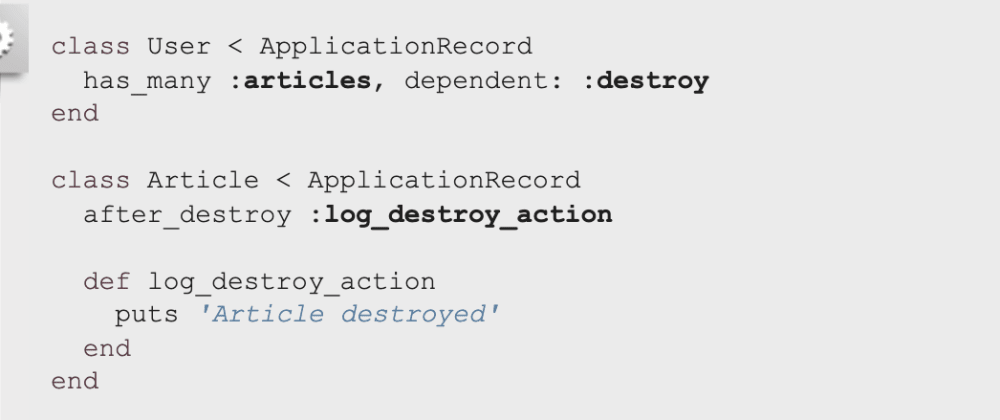
This week, we will be talking about some ActiveRecord callbacks you need to know and when to use them. In a Rails application, objects may be created, updated, and destroyed and ActiveRecord provides hooks into this object life cycle so that you can control your application and its data. This callbacks are methods or functions you want to trigger before or after the state of an object changes. You will see its usage like:
class Article < ApplicationRecord after_destroy :log_destroy_action def log_destroy_action puts 'Article destroyed' end end The above callback is called after an article has been destroyed. You could rewrite it as what we have below if what you want to do is minimal but it's more advisable to use the format above for a much cleaner code.
class Article < ApplicationRecord after_destroy do puts 'Article destroyed' end end Below is a list of the callbacks we will be going through;
- before_validation
- after_validation
- before_save
- around_save
- before_create
- around_create
- after_create
- after_save
- after_commit/after_rollback
- before_update
- around_update
- after_update
- before_destroy
- around_destroy
- after_destroy
I am sure some of the names are self explanatory so I will focus on when to use and examples of how they can be used
before_validation
Actions that trigger it: :create, :update
This callback is used before the model validation takes place. For example, for our Article model, if we want to set the title a value in the case that it is empty, we can do in a before_validation.
class Article < ApplicationRecord validates :title , presence: true before_validation :ensure_title_has_a_value private def ensure_login_has_a_value if title . nil? self . title = "Title #{ Title . all . count + 1 } " end end end after_validation
Actions that trigger it: :create, :update
This callback is used after the model validation takes place. For our Article model, if we want to capitalize the title of the article, we can do in the after_validation.
class Article < ApplicationRecord validates :title , presence: true after_validation :capitalize_title private def capitalize_title self . title = title . capitalize end end before_save
Actions that trigger it: :create, :update
This callback is called before the object is saved to the database. For our Article model, if we want to capitalize the title of the article, we can do in the after_validation.
class Article < ApplicationRecord validates :title , presence: true before_save :log_message private def log_message puts "You are about to save an article" end end around_save
Actions that trigger it: :create, :update
This callback is called around the saving the object and inside the before_save and after_save actions. Please note that you need to put a yield in the around_save method so that the action(save) can be performed. For example, if we have an article with the callbacks below;
class Article < ApplicationRecord validates :title , presence: true before_save :call_before_save after_save :call_after_save around_save :call_around_save private def call_before_save puts 'before article is saved' end def call_after_save puts 'after article is saved' end def call_around_save puts 'in around article save' yield # Article saved puts 'out around article save' end end When we initialize and save a new Article. We should have the following output;
article = Article.new(title: 'My title') article.save before article is saved in around article save out around article save after article is saved From the above output, you see that the before_save block is called first, next the around_save block. The method first logs the first line, then yields to the save action so the article can be saved to the database. After the save action is complete, control is then returned back to the call_around_save method which logs the last line and then passes control to the after_save callback.
before_create
Actions that trigger it: :create
This callback is the same as the before_save. The only difference is that it is triggered only by the create action.
Note: In a creation operation, the before_save is usually called before the before_create callback.
around_create
Actions that trigger it: :create
This callback is the same as the around_save. The difference between them is that it is triggered only by the create action.
after_create
Actions that trigger it: :create
This callback is the same as the after_save. The only difference is that it is triggered only by the create action.
after_save
Actions that trigger it: :create, :update
This callback is the executed after the object has been saved to the database. It is mostly used when you want to log database changes or track who made changes and in some case, make api call to a third party service
class Article < ApplicationRecord validates :title , presence: true after_save :tell_salesforce_i_created_a_new_article private def tell_salesforce_i_created_a_new_article puts "Send a message to salesforce via HTTPS with my details" end end before_update
Actions that trigger it: :update
This callback is the same as the before_save. The difference is that it is triggered only by the update action.
around_update
Actions that trigger it: :update
This callback is the same as the around_save. The difference between them is that it is triggered only by the update action.
after_update
Actions that trigger it: :update
This callback is the same as the after_save. The only difference is that it is triggered only by the update action.
before_destroy
Actions that trigger it: :destroy
This callback is triggered before an object is deleted from the database. You can use this to check for relationships that might be affected by its unavailability and either update those relationships or stop this action. In the case of our articles, if we have a table that saves medias or files associated with it, we can use the before_destroy callback to check that this article doesn't have a relationship saved in that table. If it exists, we can stop the action from going forward.
around_destroy
Actions that trigger it: :destroy
This callback works like the around_save but only for a destroy action.
after_destroy
Actions that trigger it: :destroy
This callback is triggered after an object has been deleted. Mostly utilized for cleanups. It can be used to update records, make an API call to a 3rd party service to notify it that the object has been deleted or trigger a background job.
after_commit/after_rollback
Actions that trigger it: :create, :update, :destroy
This callback is called after an object has been created, updated or destroyed. It can replace the after_save, after_update, after_update or after_destroy callbacks. You use this method when you want to run the same method when any of these 3 actions are executed.
Extras
after_initialize
The after_initialize callback is called whenever an object is instantiated, either by directly using new keyword or when a record is loaded from the database.
after_find
The after_find callback is called whenever Active Record finds and loads a record from the database.
Resources
- ActiveRecord Callback
- Around_save question on Stackoverflow - Answer 2
- Rails Callback Cheatsheet
- Difference between before_save and before_create - Stackoverflow
nievesbeentherize.blogspot.com
Source: https://dev.to/nkemjiks/activerecord-callbacks-you-need-to-know-5e9j
0 Response to "Rails Before Destroy Continue With Callbacks"
Post a Comment